
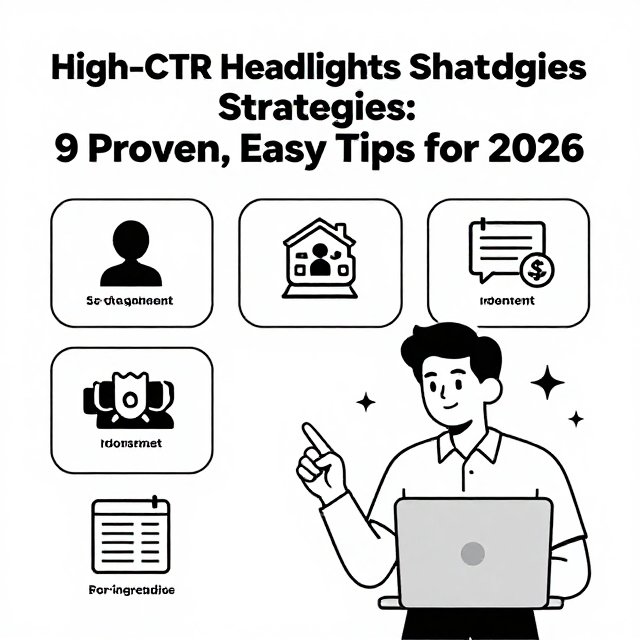
High-CTR headlines strategies help your page earn more clicks from the same search ranking. CTR means click-through rate, which is the share of people who click your result after seeing it. This article is for US bloggers, small business owners, and content marketers who want practical ways to write better titles. You will learn nine tactics, a simple scorecard, and a free way to test your results.
What Are High-CTR Headlines Strategies?
High-CTR headlines strategies are repeatable ways to write page titles that earn more clicks. They focus on clarity, relevance, and a clear reason to click. Youtube video link.
A headline is the first thing a searcher sees. It sits next to your URL and a short description. If it feels vague or off-topic, people skip it, even when your page ranks well.
These strategies do not replace good content. They help the right reader notice that your page answers their question. Think of the headline as a promise, and the page as the proof.
How Does Google Use Your Headline?
Google builds a “title link” for each result, and it often starts with your page’s title element. According to Google Search Central, its systems can also use other sources, such as headings, when they think those describe the page better.
That means your title is a strong signal, not a guarantee. Google’s documentation advises titles that are descriptive and concise. It also warns against keyword stuffing and repeated, boilerplate titles. You can read the details in Google’s guide to title links.
Google also says its ranking systems favor content made for people first. See its guidance on helpful, reliable, people-first content. A headline that misleads people breaks that principle.
What Are the 9 Best High-CTR Headline Tactics?
The best tactics make a headline specific, relevant, and honest. Use them as a menu, not a formula. Most strong titles use three or four at once.
1. Put the main keyword first
Lead with the phrase people typed. It confirms relevance at a glance. A title that opens with the topic is easier to scan than one that buries it.
2. Promise one clear benefit
Say what the reader gets. “Cut your editing time” is clearer than “Editing advice.” Pick one benefit so the title stays short.
3. Add a specific number
Numbers set expectations. “7 Steps” tells readers how long the article is. Use odd or exact numbers only when your content truly contains that many items.
4. Match search intent
Ask what the searcher wants to do. A person searching “how to” wants steps. A person searching “best” wants a comparison. Your headline should signal the same format.
5. Use a power word with care
Words like “Simple,” “Proven,” “Essential,” or “Free” can add pull. Use them only when true. One strong word is enough.
6. Keep it short enough to read
Google does not set a fixed character limit. Long titles can be cut off in results, so about 60 characters is a common working rule. Put key words early so a cut-off title still makes sense.
7. Add the year for fresh topics
A year like 2026 signals that content is current. Use it only if you really update the page each year. An old date on stale content hurts trust.
8. Raise curiosity without hiding the answer
Give a reason to click, but do not trick people. “Why Most Headlines Fail” works only if the page explains why. Vague teasers often earn clicks and quick exits.
9. Write for one reader
Name the audience when it helps. “For Small Business Owners” filters in the right people. It can also filter out people who would not have found the page useful.
How Do You Score a Headline Before Publishing?
Score each draft against five checks and keep the highest scorer. This original scorecard gives each check 0 or 1 point. A score of 4 or 5 is ready to publish.
- Clear topic: Does the main keyword appear in the first few words?
- Clear benefit: Can a stranger tell what they will gain?
- Right format: Does the title match the intent, such as how-to, list, or comparison?
- Honest promise: Does the page deliver exactly what the title says?
- Short and scannable: Can you read it in two seconds without losing the point?
Write three to five drafts, score each, and pick the best. If two tie, choose the one that sounds most like how your reader talks. This also builds a record of what you tried, which helps when you review results later.
For related habits, see our post on writing meta descriptions that match search intent.
How Do You Test Headlines in Google Search Console?
You test headlines by changing one title and comparing CTR before and after. Google Search Console is free and shows clicks, impressions, and CTR for your pages.
- Open Search Console and choose your site property.
- Go to Performance, then Search results.
- Add a Page filter for the article you plan to change.
- Record clicks, impressions, CTR, and average position for the last 28 days.
- Update the title and note the exact date.
- Wait at least 2 to 4 weeks. Then compare the same length of time after the change.
- Check that average position stayed similar. If it dropped, ranking changes may explain the CTR shift.
Change one thing at a time. If you edit the title, meta description, and content together, you cannot tell what worked. Google explains each metric in its Performance report help page.
Seasonal topics can distort results. A recipe page may get more clicks in November no matter what the title says. Compare against the same period when you can.
Which Headline Formats Work Best?
No single format wins every time. The best choice depends on the search intent and the topic. This table compares five common formats.
| Headline format | Best for | Example pattern | Main risk |
|---|---|---|---|
| Numbered list | Tips, tools, ideas | “9 Tips to Improve Titles” | Padding the list to reach the number |
| How-to | Step-by-step tasks | “How to Write Better Titles” | Too generic without a benefit |
| Question | Answer-style searches | “What Makes a Good Title?” | Page must answer fast |
| Comparison | Product or method choices | “Option A vs. Option B” | Needs a fair, clear verdict |
| Benefit statement | Service or sales pages | “Cut Editing Time in Half” | Overpromising what you can prove |
Match the format to what the searcher expects. Informational searches often fit how-to and list titles. Commercial searches often fit comparison titles.
What Are the Pros and Cons of Headline Optimization?
Headline optimization is cheap and fast, but it has limits. It can raise clicks, yet it cannot fix weak content or low rankings.
Pros:
- You can improve results without publishing a new page.
- Search Console gives free, direct feedback.
- Better titles can set clearer expectations for readers.
Cons:
- Google may rewrite your title in results.
- CTR changes can take weeks to measure.
- Clickbait can raise clicks but lower trust.
Treat CTR as one signal among many. A page with a lower CTR but strong reader satisfaction is often healthier than a clickbait page.
How Much Does Headline Testing Cost?
Basic headline testing costs nothing. Google Search Console is free to use, and you can edit titles in your content management system. Some third-party SEO tools charge monthly fees, and prices change often, so verify current pricing on each tool’s official site. You do not need a paid tool to run the process in this article.
What Mistakes Lower Headline CTR?
Most CTR problems come from unclear or misleading titles. Avoid these common errors:
- Stuffing keywords. Repeating a phrase makes the title look spammy.
- Using the same pattern everywhere. Identical titles across pages blur together.
- Overpromising. If the page cannot deliver, readers leave and may not return.
- Burying the topic. Starting with filler words wastes your best space.
- Changing titles too often. Constant edits make results hard to read.
- Ignoring the search results page. Search your own keyword and look at competing titles first.
- Forgetting mobile. Titles may look shorter on small screens, so check yours on a phone.
What Tips Help US Readers Click?
US readers respond best to plain, direct language. Use US spelling, such as “color” and “organize.” Show prices in dollars and use clear, familiar terms.
For local or seasonal topics, name the US context when it applies. Examples include “for US small businesses” or “for tax season.” Avoid slang that may confuse people outside your audience. Keep the title easy to read at a glance, since most people scan results quickly.
For help choosing the right topics to target, read our guide to keyword research for beginners.
FAQ
What is a good CTR for a headline?
There is no single good CTR. It varies by ranking position, search intent, and industry. A result in position one usually earns a higher CTR than one lower on the page. Compare your own pages over time in Search Console instead of chasing an outside number.
How long should an SEO headline be?
Google has no fixed limit, but about 60 characters is a common guideline. Longer titles may be cut off in results. Put your main keyword and benefit near the start so the title still works if it is shortened.
Do numbers in headlines really help?
Numbers often help because they set a clear expectation, such as how many tips or steps to expect. They work best when the content truly matches the number. Forced or padded lists can disappoint readers and hurt trust.
Will changing a headline affect my rankings?
It can, in either direction. Google may treat the new title as a different signal, and search results can shift. Change one page at a time, record the date, and watch position as well as CTR in Search Console.
Does Google always show my title tag?
No. Google’s systems may use other sources, such as page headings, when they think those describe the page better. Writing a clear, descriptive title makes it more likely that Google uses it as written.
Is clickbait ever worth it?
Clickbait may raise short-term clicks, but it often leads to quick exits and lost trust. Google’s helpful content guidance favors content made for people first. A curious, honest headline works better than a misleading one.
Next Step
Better headlines come from clear promises, honest wording, and steady testing. Pick your three lowest-CTR pages in Search Console and score new title drafts with the five-point scorecard. Update one page, record the date, and check results in a few weeks.
Click here for last article Techpks.com

1 comment